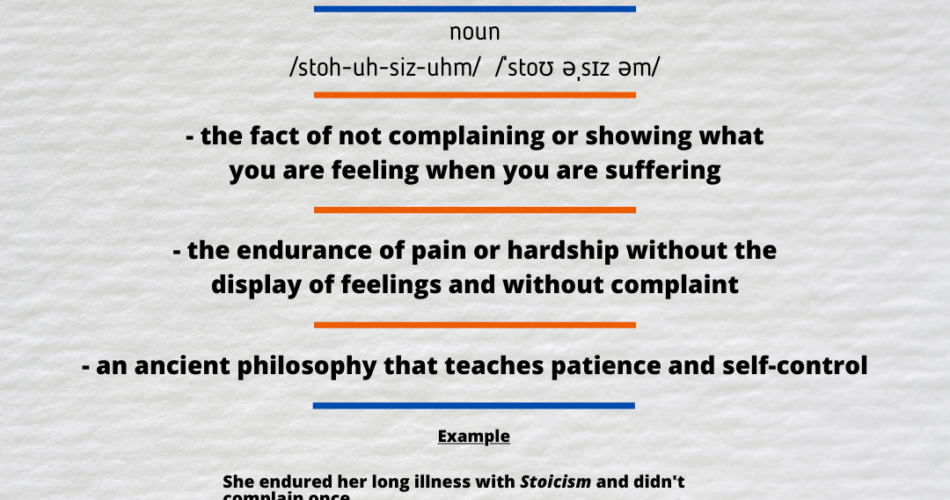
Bienvenidos al blog de lingüística, donde hoy exploraremos el significado de una palabra que ha sido objeto de debate y discusión a lo largo de la historia: «Stoic». En este artículo, analizaremos el origen y la evolución de este término, así como su uso en la lengua inglesa. Nos adentraremos en sus connotaciones y matices, para comprender completamente su significado y su impacto en la cultura y la literatura. Acompáñanos en este fascinante viaje a través de la historia y la lingüística, mientras descubrimos juntos «The Meaning of Stoic in English».
Índice
What does it mean to be a stoic person?
Stoicism is a philosophy that originated in ancient Greece, and its teachings have influenced many prominent thinkers throughout history. At its core, being a stoic person means living a life of rationality and virtue, while accepting that there are things outside of our control.
The word «stoic» has come to mean someone who is unemotional or indifferent to pain, pleasure, or other people’s opinions. However, this is a misunderstanding of the philosophy. Stoicism does not advocate for the suppression of emotions, but rather the cultivation of emotional resilience and self-control.
Stoics believe that the key to a good life is to focus on what is within our control, and to accept with equanimity the things that are beyond our control. This means that stoic individuals strive to live in accordance with reason, rather than their passions or desires. They understand that external events are indifferent, and that true happiness comes from within.
Epictetus, one of the most famous stoic philosophers, taught that we should focus on our own thoughts and actions, rather than trying to control external events or other people’s behavior. He believed that the only thing we truly have control over is our own mind, and that by cultivating inner peace and tranquility, we can live a fulfilling life.
Being a stoic person does not mean that one should be emotionless or disconnected from others. Instead, it means recognizing that emotions are a natural part of the human experience, and learning to respond to them in a constructive way. Stoic individuals strive to be virtuous and compassionate, while also recognizing that life is unpredictable and that we must be prepared to face challenges with resilience and determination.
In conclusion, being a stoic person means living a life of reason, virtue, and inner peace, while accepting the things that are beyond our control. It means cultivating emotional resilience and self-control, while also striving to be virtuous and compassionate. By following the teachings of stoicism, we can live a fulfilling and meaningful life, no matter what external events may come our way.
What is the literal meaning of stoic?
Stoicism is an ancient Greek philosophy that emphasizes the development of self-control and fortitude as a means of overcoming destructive emotions and impulses. The word «stoic» comes from the Greek word «stoa,» which means «porch» or «colonnade.»
The Stoics used to gather and teach philosophy on the porch of a public building in Athens, and this is where the name comes from. The word «stoic» has come to mean someone who is indifferent to pain, pleasure, or emotions in general. However, this is not the literal meaning of the term.
The literal meaning of «stoic» is someone who is a follower of the philosophy of Stoicism. The Stoics believed that the universe is rational and that everything that happens in it is determined by reason. They believed that the only thing that individuals can control is their own thoughts and actions, and that they should strive to live in accordance with nature and reason.
The Stoics also believed in the importance of developing a sense of inner peace and tranquility, regardless of external circumstances. This is why the modern meaning of «stoic» as someone who is unemotional and indifferent is not entirely accurate.
In conclusion, the literal meaning of «stoic» refers to someone who follows the philosophy of Stoicism, which emphasizes self-control, rationality, and inner peace. While the modern usage of the term has shifted slightly, it is still important to understand the original meaning of the word to fully appreciate the philosophy behind it.
What does stoic mean in one word?
When someone is described as stoic, it means they are able to endure pain or hardship without showing their feelings or complaining. The word stoic comes from the philosophy of Stoicism, which was founded in Athens by the philosopher Zeno of Citium in the early 3rd century BCE.
Stoicism teaches that we should focus on what we can control and accept what we cannot control. This means that stoic people are often seen as calm and rational in the face of adversity. They do not let their emotions control them, but instead, they control their emotions.
Being stoic does not mean that one should be emotionless or suppress their feelings. Rather, it means that one should be aware of their emotions and not let them overwhelm them. Stoic individuals are able to acknowledge their feelings and work through them in a logical, rational manner.
Overall, the word stoic has a connotation of strength and resilience. To be stoic is to be able to face challenges and difficulties with grace and composure.
Is stoic positive or negative?
Stoicism is a philosophy that originated in ancient Greece and has gained popularity in modern times. It emphasizes the importance of self-control, rationality, and the acceptance of fate. However, there has been some confusion over whether stoicism is a positive or negative philosophy.
On one hand, some may view stoicism as a negative philosophy because it often involves suppressing emotions and accepting unpleasant situations. This can be seen as a pessimistic approach to life. However, this interpretation overlooks the positive aspects of stoicism.
Stoicism teaches individuals to focus on what they can control and to let go of what they cannot. This mindset can lead to a sense of inner peace and contentment, even in the face of adversity. It also encourages individuals to take responsibility for their own happiness, rather than relying on external factors.
Furthermore, stoicism emphasizes the importance of living in accordance with nature and the universe. This includes treating others with kindness and respect, and striving for personal growth and improvement. These values align with many positive aspects of human nature.
Overall, stoicism can be viewed as a positive philosophy that promotes self-discipline, inner peace, and personal growth. While it may involve accepting difficult situations, it also emphasizes the importance of taking control of one’s own life and living in harmony with the world around us.
Conclusión
En resumen, el término «stoic» en inglés se refiere a una persona que acepta el sufrimiento y el dolor con fortaleza y sin quejarse. El concepto se origina en la filosofía estoica, que aparece en la antigua Grecia y Roma. A lo largo de la historia, este término ha evolucionado y se ha utilizado en diferentes contextos, incluyendo la literatura y la cultura popular. En la actualidad, el término sigue siendo relevante y se utiliza para describir a personas que mantienen la calma y la compostura en situaciones difíciles.